


 The latest T1D content
 Research that matters
 Our daily questions
 Continue with Google
 Continue with Facebook

We’re celebrating six years of the T1D Exchange Registry! Since its online launch in 2019, we’ve gathered the stories of over 22,000 people with type 1 diabetes (T1D) to analyze trends in health and diabetes management changes over time. The data points we’re sharing in this article show clear movement toward more automated, connected, and discreet tools and technologies.
The T1D Exchange Registry is a long-term research study open to adults and caregivers of children with T1D living in the U.S. Participants complete a questionnaire once per year and can participate in other optional research studies through their registry dashboard.
If you are not yet part of the T1D Exchange Registry, join us!
To mark the anniversary of our online registry, we want to show some of the changes we’ve seen in technology and daily management over the past six years.
In this article, we’re looking at changes in device usage and daily management among participants in the T1D Exchange Registry, comparing data from the early days of the registry (2019), “Then,” to the present (2025), “Now.”
We’ll look at the “Then” and “Now” for:
- Insulin pump usage rates
- Most commonly used insulin pumps
- Most commonly used insulin pens
- Continuous glucose monitor (CGM) usage rates
- Most commonly used CGMs
- Frequency of glucose meter checks
Here’s how technology and treatment patterns in our online registry have evolved since it began in 2019.
Insulin Delivery: More People Are Using More Advanced Pumps
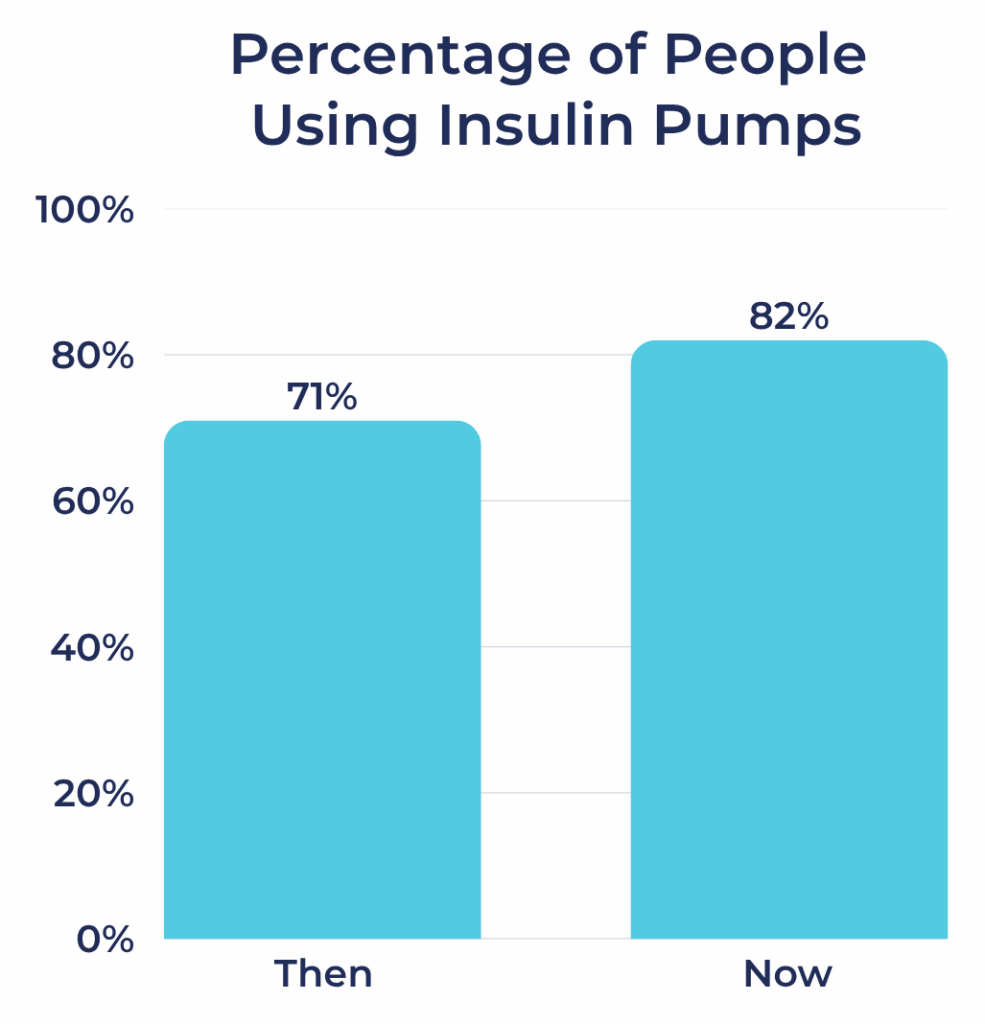
In 2019, 71% of people with T1D in our registry used insulin pumps. Today, that number has climbed to 82%, possibly reflecting growing trust in automated insulin delivery systems and expanded access through insurance coverage and device approval pathways.
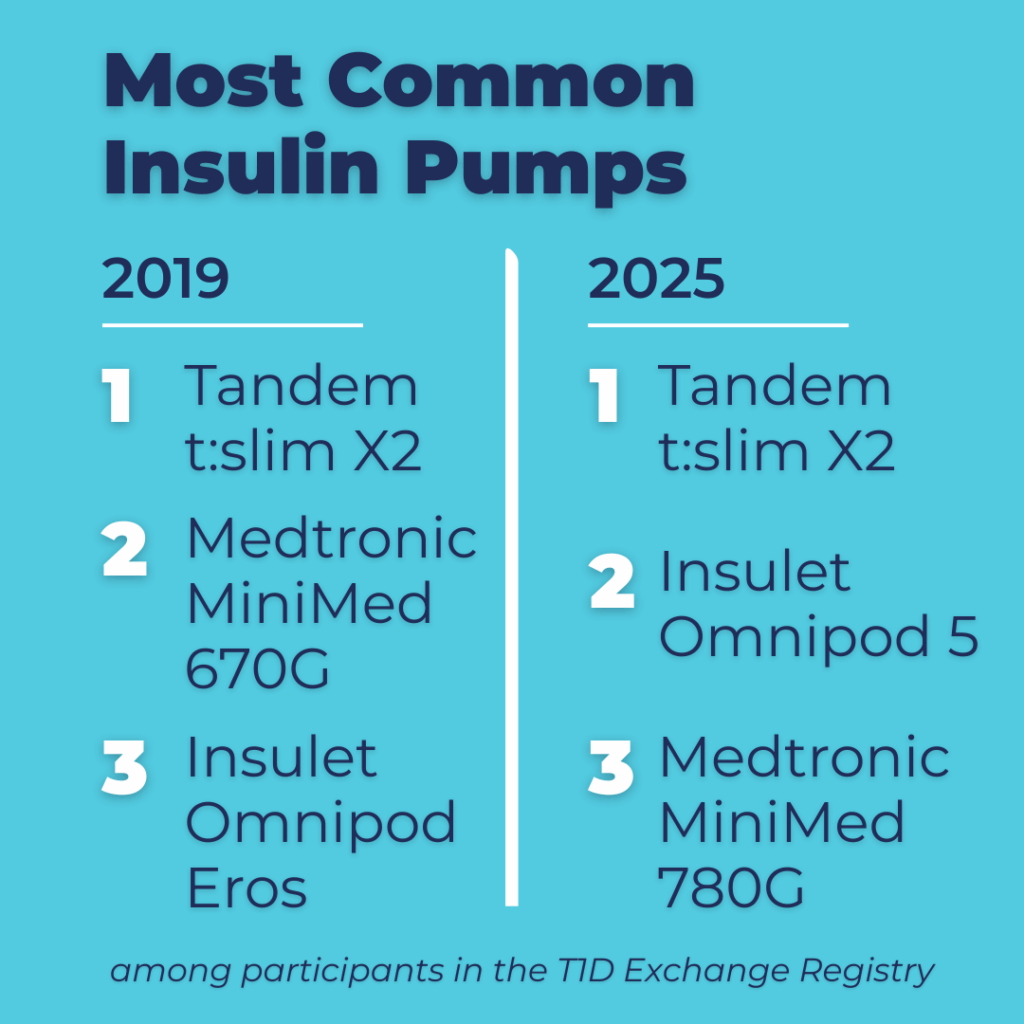
Top 5 Most Commonly Used Insulin Pumps Among Pump Users in our Registry
Then:
- Tandem t:slim X2
- Medtronic MiniMed 670G
- Insulet Omnipod Eros (Original)
- Insulet Omnipod DASH
- Medtronic MiniMed 630G
Now:
- Tandem t:slim X2
- Insulet Omnipod 5
- Medtronic MiniMed 780G
- Tandem Mobi
- Insulet Omnipod DASH
In 2019, our registry participants’ most commonly used insulin pumps were the Tandem t:slim X2, Medtronic MiniMed 670G, and the original Insulet Omnipod (also known as Omnipod Eros). The Omnipod DASH system was gaining traction, and fewer people were using the Medtronic MiniMed 630G as MiniMed pump users moved toward the 670G.
Now, in 2025, the market has shifted dramatically.
Though the Tandem t:slim X2 is still the most commonly used insulin pump by participants in our registry, people are using the t:slim at a higher rate, and the new Tandem Mobi is growing in popularity. The Medtronic MiniMed 670G is no longer available, as newer MiniMed pumps, particularly the 780G, have entered the market. The original Insulet Omnipod was discontinued at the end of 2023, about a year after the Omnipod 5 system with automated insulin delivery became commercially available.
Insulin Pens: Subtle Changes in Preferences
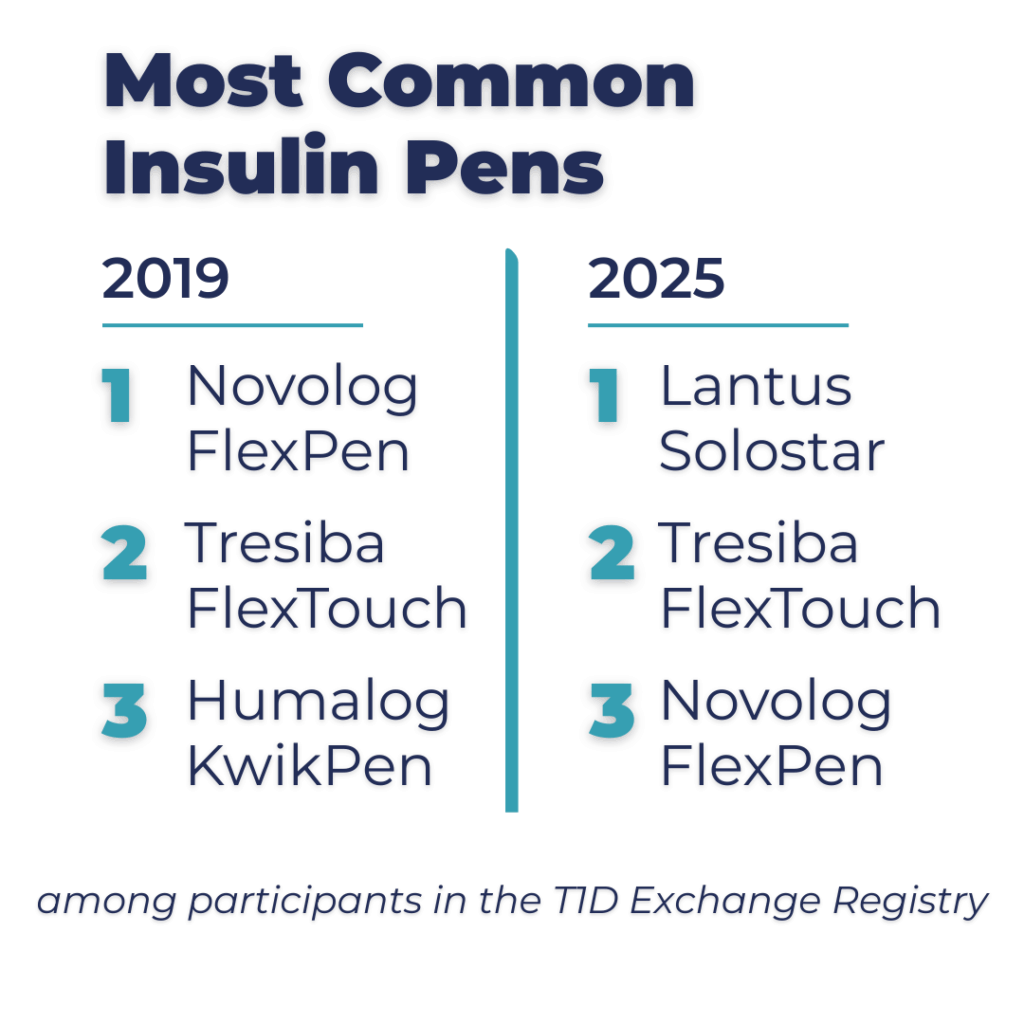
Top 5 Most Commonly Used Insulin Pens by Registry Participants
Then:
- Novolog FlexPen
- Tresiba FlexTouch
- Humalog KwikPen
- Lantus Solostar
- Basaglar KwikPen
Now:
- Lantus Solostar
- Tresiba FlexTouch
- Novolog FlexPen
- Humalog KwikPen
- Basaglar KwikPen
Although insulin pump usage has grown, many people still use insulin pens, including 22% of our registry participants in 2025. The top five pens have remained the same, but slight shifts may suggest changes in preferences and accessibility.
The shifts in insulin pen usage are modest, with Lantus becoming the most frequently used pen, and a slight decrease in the use of Basaglar.
CGM Use & Glucose Monitoring
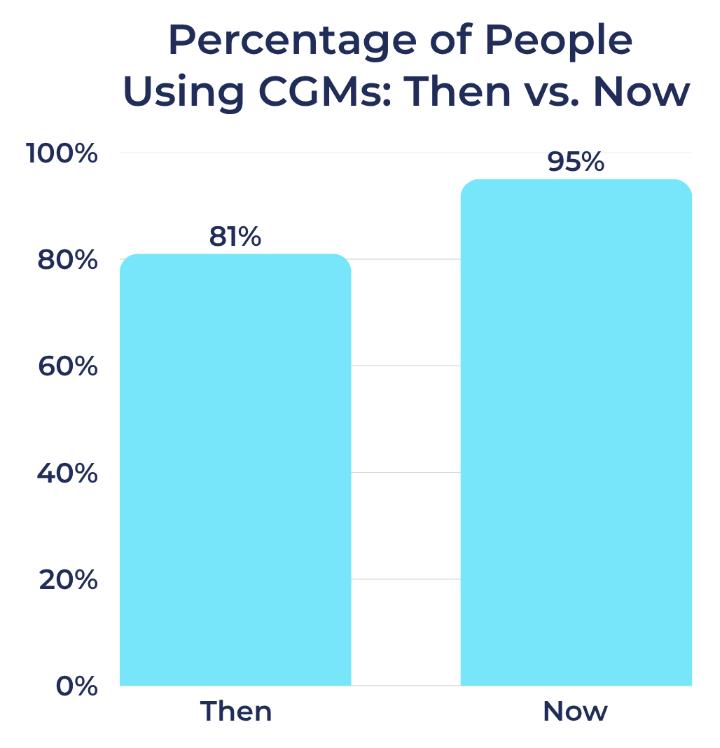
Six years ago, 81% of participants in the T1D Exchange Registry used a CGM. Now, 95% of people with T1D in our registry report using a CGM.
The CGM landscape has changed a lot in six years, with newer CGMs needing fewer calibrations and shorter warmup periods. We’ve also seen changes in insurance coverage for CGMs over the past several years, as well as broader recommendations for CGM usage as the standard of care for people with T1D.
Now, CGMs are often viewed as essential tools by people with T1D, their loved ones, and their healthcare providers.
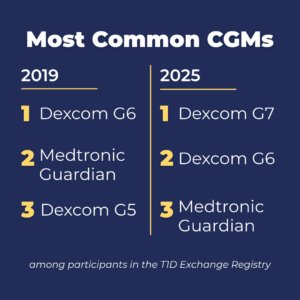
Top 5 Most Commonly Used CGMs Among CGM Users in our Registry
Then:
- Dexcom G6
- Medtronic Guardian 3
- Dexcom G5
- Abbott FreeStyle Libre 14-Day System
- Medtronic Guardian Connect System
Now:
- Dexcom G7
- Dexcom G6
- Medtronic Guardian 4
- Abbott Freestyle Libre 3
- Medtronic Guardian 3
According to registry data, the Dexcom G6 dominated the field in 2019, though some people were still using the Dexcom G5 at that time. Medtronic’s Guardian 3 sensor was in our top 5, as was their standalone CGM system, the Guardian Connect. The Abbott FreeStyle Libre 14-Day System also had many users before the approval of the Libre 2 in 2020 and the Libre 3 in 2022.
Now, the majority of people who use a CGM in our registry use a Dexcom CGM, nearly split in half between the G7 and G6. The Medtronic Guardian 4 sensor has grown in popularity since its release in 2023. The Abbott FreeStyle Libre 14-Day System has now been replaced in the top 5 most frequently used CGMs by the newer Libre 3.
Blood Glucose Measuring: Decline in Fingerstick Use
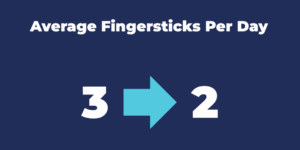
Average blood glucose checks with a meter:
- Then: 3
- Now: 2
While CGM usage among our registry participants has increased, the average number of daily fingerstick glucose checks has decreased. Six years ago, participants in our registry checked their blood glucose on average three times per day. Now, that number is two times per day, potentially indicating growing confidence in CGM data and sensor accuracy.
The Big Picture: A Move Towards Automation and Simplicity
Over the past six years, trends in the T1D Exchange Registry show that T1D management has increasingly shifted towards more automated, connected, and discreet systems. Pumps and CGMs are now more advanced and widely used, with many integrating technology that automatically adjusts insulin delivery based on glucose readings.
In the coming weeks, we’ll share more insights from the T1D Exchange Registry at T1DExchange.org!
And if you haven’t already, join our registry today!
Note: The data in this article doesn’t show cause and effect and shouldn’t be seen as the final word on T1D. It only represents the individuals who have participated in the T1D Exchange Registry between 2019 and 2025; it does not represent the entire T1D population. This data represents a limited, though valuable, perspective on the landscape of type 1 diabetes.