We recently asked our T1D Exchange Online Community this question: “In what ways has diabetes positively influenced your life?” The honest and inspiring responses reminded us that even in the toughest journeys, there are still bright spots.
“I’ve learned a lot of good things about myself. I’m skilled at multitasking. Being a ‘numbers nerd’ is an asset, and I’ve become more aware of the impacts that a diagnosis or medical issue can have on other people,” shared one member of the T1D Exchange Online Community.
“The result: I have more empathy. Learning to adapt to life with T1D made it easier for me to support my partner’s Parkinson’s diagnosis. I’ve also learned how to advocate for myself in the healthcare system — and I share that knowledge. Plus, the demands of T1D have made me more fit and in better shape than most of my friends.”
Receiving a type 1 diabetes (T1D) diagnosis is never anyone’s wish. It arrives uninvited, often abruptly, and it’s always life changing. But over time, something surprising can happen. Amid the challenges, many people discover unanticipated growth and positive change.
I know this not only as someone living with type 1, but also as a parent of a child who was diagnosed at age five. I understand the disrupted sleep, emotional baggage, and the invisible mental load.
And still, I have seen — even amid daily demands — resilience take root. Confidence builds. Empathy deepens. Advocacy sharpens. All the while, quietly shaping who we become.
Here, we’ll explore those unexpected positives — not to minimize the challenges, but to acknowledge the strength, awareness, and perspective that can emerge from a life touched by type 1 diabetes.
What research has to say
Research reflects this same complexity — one of significant burden and meaningful growth. It mirrors what so many in the T1D community already know: both can be true at the same time.
Life with T1D is demanding.
Studies consistently document the daily disruptions, interrupted sleep, relentless decision-making, financial strain, and the constant vigilance to live safely with T1D.
The burden is constant. It can affect mental health, relationships, and career paths. It informs healthcare delivery and smarter policy.
Understanding these realities is essential. And yet, research also shows many of the “positives” people describe are often a built-in response to these very stressors. In other words, growth doesn’t cancel hardship — it grows alongside it.
In a qualitative study, adults with T1D described how their long-term experiences have shaped their perspective. Six key themes emerged. Among them: T1D doesn’t define you. It should not limit your life. Support matters. Education matters. A sense of normalcy matters.
Other research involving adults with type 1 and type 2 diabetes (T2D) suggests that inviting people to reflect on positive experiences may help healthcare providers foster more balanced, supportive conversations.
Another study of health-related quality of life in young adults with T1D shows that quality of life is shaped by more than clinical metrics alone — context, stage of life, and personal meaning all play a role.
Finally, a Swedish study sought to understand the lived experience of adults diagnosed with T1D as children. Participants commonly likened type 1 to a “lifelong journey of personal learning,” in which individuals continually reconstruct what it means to live with chronic disease — ultimately weaving it into a life filled with purpose.
Taken together, the evidence suggests that over time, many people develop perspective, resilience, and self-understanding that might not have emerged otherwise.
What our community shared
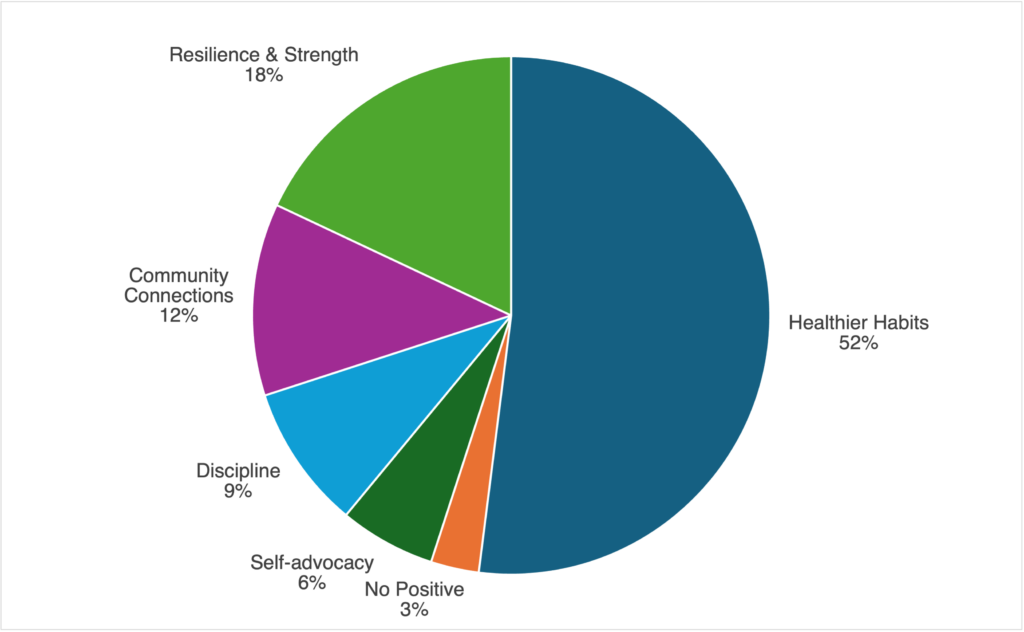
When we analyzed community members’ responses, clear themes began to emerge. Let’s take a look at what they are.
T1D Exchange Question of the Day: In what ways has diabetes positively influenced your life?
Healthier habits and self-discipline
One of the most common responses was centered on healthier lifestyle habits — improved nutrition, consistent exercise, weight management, and reduced alcohol use.
It’s given me a reason to take care of myself.
I’m very health conscious as a result. Much more than most family and friends.
Diabetes has taught me about nutrition and making nutritious choices. It’s also encouraged me to exercise.
Diabetes has forced me to have a more regimented life when it comes to diet and exercise. I probably wouldn’t be as disciplined without it. People tell me I look 10 years younger than my 58 years. I think a lot of that is attributed to how I take care of myself.
Connections, resilience, and mental strength
Others described developing resilience, mental toughness, and adaptability over time. Many pointed to stronger self-advocacy skills, greater medical awareness, and meaningful connections within the diabetes community.
Diabetes has made me a more organized, accountable, responsible person.
It’s made me mentally tougher. When someone said, ‘You can’t do that,’ my response became, ‘Oh yeah? Watch me.’
It’s helped me become much more resilient in life’s ups and downs.
All of the amazing and wonderful people that I’ve met — my tribe!
In so many ways, I cannot even list them. I say I’m a ‘better everything’ because of type 1.
When it’s hard to see the positives
Not everyone finds it easy — or even possible — to name a silver lining.
Some respondents shared mixed feelings and acknowledged that finding positives can be difficult.
For me, it’s hard to find positive ways considering the many doctor appointments and physical effects that I must deal with on a daily basis. What is positive are the many people I have met who have shared words of encouragement and their journey of living with diabetes. For that I am grateful.
It’s hard to say anything positive.
The bottom line
The challenges of type 1 diabetes are real. They are relentless. But so, too, is the capacity for growth. Sometimes, strength doesn’t arrive despite hardship — it arrives because of it.
Many people living with T1D can point to greater awareness, resilience, discipline, empathy, and connections that have developed over time. Those qualities don’t erase the burden — but they help broaden the picture.