

 The latest T1D content
 Research that matters
 Our daily questions
 Continue with Google
 Continue with Facebook

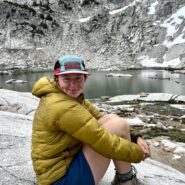
Standing on the top of Mt. Whitney felt different this time. The high alpine sun still kissed the High Sierra mountains, and I could still taste the success of summiting the highest peak in the contiguous United States at 14,505 ft., but now, the summit meant more. It was a shared triumph of leadership, grit, and unshakable resilience with the next generation of teenagers who live with type 1 diabetes (T1D). Together, we showed that with T1D, anything is possible.
In 2019, at just 15 years old, I had the incredible opportunity to climb Mt.Whitney with Diabetes Youth Families (DYF). Backpacking 70 miles across the rugged Sierra Nevada was one of the best things I’ve ever done for my relationship with diabetes. It taught me that no goal is too big, and that type 1 doesn’t have to slow me down, especially in the mountains.
Standing on the summit in 2019, I vowed that one day, I’d return as a leader to help inspire and change the lives of other teenagers with diabetes, just like the program had once done for me. Six years later, I was back on top of Mt. Whitney — this time, with seven teenagers.
For two weeks, we normalized T1D on the trail. Quickly, diabetes felt less isolating, the fear of “slowing down the group” to treat a low disappeared, and blood sugars were seen solely as data points — similar to our daily mileage or elevation gain. In a sense, diabetes was easier to manage in the wild because everyone “got it.” The mental weight of diabetes was blown away and replaced with a symphony of Dexcom beeps.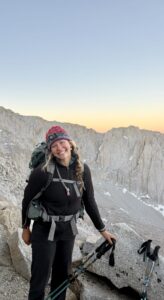
Over our many shared miles, nuggets of trail wisdom emerged. Unlike the mountains and the slow rhythm of life on the trail, these lessons were things we could bring home. We learned about “time in range” versus “time in happiness,” that diabetes is both an art and a science, and how magical the diabetes community is. Most importantly, we recognized this opportunity existed because of diabetes, not in spite of it.
Lesson 1: Time in Happiness vs. Time in Range
Every decision with T1D is based on numbers. Our lives revolve around our blood sugar levels, where they’ve been, and where they’re going. Somewhere along the way, it’s easy to confuse trend lines with self-worth. I’ve fallen into this trap many times, but thanks to diabetes camp, I’ve learned that there are no “bad” numbers and that this data doesn’t have the power to define our happiness.
“Time in range” is important for health, but “time in happiness” is just as important — or more important — especially in the mountains. Despite failed sites, rollercoaster blood sugars, ketones, and a broken pump, we didn’t let diabetes get in the way of our happiness on the trail. The hardships never erased the joy of living from our backpacks.
On day two, this was no less true when one of my campers jumped into the river with his pump on, accidentally destroying the device. After some stressful leadership team brainstorming, we used my backup phone with DIY Loop installed and pooled together enough Omnipods to support his needs.
As for the camper, in the end, he was glad the whole experience happened. “I got to try a new pump system, got a great story, and was able to persevere through a stressful moment in the backcountry,” he said.
It was a highlight for me, too, seeing how capable we are of problem-solving and lifting each other up. We didn’t let diabetes mishaps take away the fun.
Lesson 2: Diabetes is an Art, not a Science
If I’ve learned anything since my diagnosis twelve years ago at age nine, it’s that no day with diabetes is ever the same.
One of my campers, who’s lived with diabetes since age two, said, “Diabetes is like an abstract piece of art. You could eat the same breakfast every day and start at the same blood sugar, but one day you will cruise at 120, and the next go to 400.” No matter how much you know about diabetes, or how many equations and tricks you have up your sleeve, every day with T1D is different. Because of this, diabetes needs to be approached with creativity and flexibility.
In the mountains, an at-home diabetes routine needs to be fully reconsidered. Giving up this sense of control can be scary, but when well supported, trial and error becomes your best friend. This was evident in every diabetes-related decision we made. Our med staff approached every carb count and setting change with a mentality of “Try it and see what happens.” Establishing this relationship around trial and error made frustrating moments more manageable.
Lesson 3: The Diabetes Community is Magical
Shortly after my T1D diagnosis, I attended diabetes camp for the first time. Here, I was embraced by a community unlike any other I had ever experienced — filled with unlimited love, knowledge, and understanding.
I’ve always deeply appreciated the diabetes community, especially DYF. However, being in a leadership role and witnessing the relationships form between my campers and others on-trail gave me a newfound gratitude.
As leaders, we woke up at midnight and 3 a.m. to check every camper’s CGM. We talked about diabetes without stigma and welcomed every question and conversation that other people traversing the Sierra asked us.
The day before our summit, we were approached by a father-daughter duo who had heard about us from other hikers a few days prior. It turned out they both lived with type 1, too. Connecting with them, even deep in the mountains, magnified the power of our community.
This magic followed us home, as we paraded back into camp with the entire Bearskin Meadows Camp community celebrating our accomplishment. It was a powerful rush of emotions and love. Most importantly, it became living proof that we didn’t just summit for ourselves. Instead, this group of T1D teenagers was already inspiring the next generation of campers — an endless cycle.
We’re getting closer to conquering T1D, thanks to science and medical research. Until then, the vulnerability and tenderness that exists in this community are almost as powerful as a cure.
Lesson 4: Because of Diabetes, Not in Spite of It
When I participated in this program as a camper, I felt a sense of pride knowing we were climbing this mountain “because of diabetes, not in spite of it.” Diabetes led us here, to this mountain, to these friendships, to this experience, and because of that, I’ve developed a gratefulness toward this disease.
I’ve learned that you can’t let the frustrating aspects of diabetes take over your life.
Every night, we discussed the hardships and strengths that come with T1D. We explored how diabetes affects our relationship with food, what aspects are the most challenging, how it sets us apart, and motivates us to do difficult things.
Campers shared how impactful these programs have been for their management, how they’ve learned to let diabetes take up less space, and to share this part of themselves more confidently. Conversations resonated with everyone, reminding us that diabetes, though “invisible,” does not make us alone in our hardships. Each of these “fireside chats” healed a part of my inner teenage self that grew up with type 1.
On the summit, basking in our success, everyone shared how summiting Whitney impacted them. One of my campers shared, “This experience made me love myself more.” She went on to explain, “You can’t fully love yourself if you don’t love your diabetes, because diabetes is such a big part of you.”
If I brought anything with me down the mountain, it’s this.
Returning Home:
Returning home from the backcountry can be a tough transition. Going from an environment where diabetes is the norm to one where you may be the only person living with it can feel confusing. Understanding the significance of this accomplishment, both physically and mentally, can be challenging.
I’m fortunate to share my life with T1D alongside my mom, who also lives with T1D and normalized diabetes for me as I was growing up. For many people, their return is often more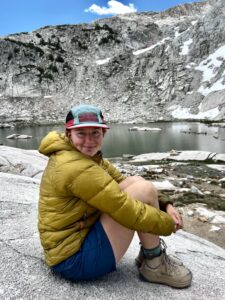 complex.
While diabetes will always present challenges, it continually offers us the power to live boldly, the determination to succeed, and the grit to conquer any mountain we put our minds to. The triumphs we share, the community we build, and the lessons we take with us will always remind us that together, we are unstoppable.