For more than a decade, the T1D Exchange Online Community has come together each day to answer our Question of the Day. Each response helps deepen our collective understanding of life with type 1 diabetes (T1D), but also sparks new ideas, inspires support, and drives real change in research and care.
Because of you, this space is vibrant, supportive, and engaging.
Curious about what sparked the most conversation lately? Let’s dive into some of our top-asked questions.
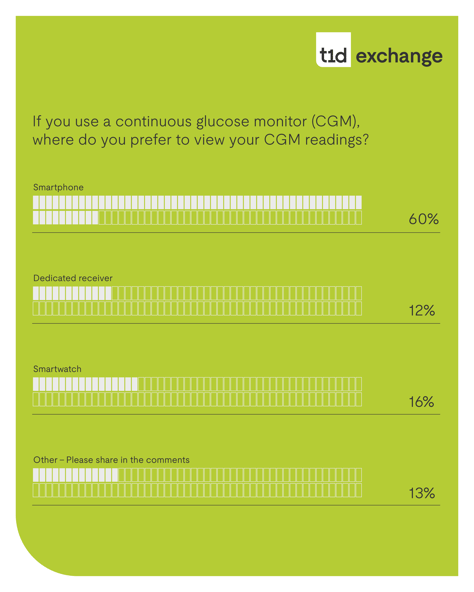
If you use a continuous glucose monitor (CGM), where do you prefer to view your CGM readings?
Community members reported viewing their CGM data on a pump, smartphone, or smartwatch — often switching between devices — depending on the situation. Whether they’re exercising, driving, or managing insulin delivery, respondents value having multiple ways to access their glucose data.
”
I said my watch, but the only problem is that it’s hard to get all the pieces of software to communicate. I use a Fitbit, and things have been difficult since Google bought it. At the moment, the stars seem to be properly aligned.
I look at my insulin pump — less extra items to carry around.
Watch if I’m just checking, pump app on phone if bolusing, third-party app (Sugarmate) on phone overnight in nightstand mode — don’t have to touch anything, just open my eyes to check.
My pump, but I’m using my smartphone more and more.
I like seeing my readings on my smartphone and my watch.
Mostly my pump because I want to quickly see insulin on board.
Community members emphasized that device preferences are highly situational, pointing out:
- Convenience and accessibility often determine which device is used at any given time
- Insulin pumps remain the primary hub for diabetes management and decision-making
- The ability to access data across multiple devices is highly valued
- Smartwatches offer a convenient and discreet way to monitor glucose levels
- Smartphones are preferred for reviewing trends, history, and more detailed diabetes data
On a scale of 1-5, how insulin-resistant would you say you are?
For many, assigning a number to their insulin resistance wasn’t straightforward. Responses frequently highlighted how insulin needs can fluctuate over time and how difficult it is to define or measure insulin resistance in everyday life.
”
I’m a very Type-A personality and T1D for 60 years. Both of those can increase my resistance. Stress is my worst enemy!
Great question, I take Metformin, Acarbose, and Jardiance to help overcome it. Some days it helps. My daily dose is still creeping up. My endo surmises that I have type 2 on top of type 1.
I said, ‘Not resistant at all.’ I cannot say that I understand the concept of ‘insulin resistance.’ I know that I need more insulin in the morning, but I don’t use large quantities of insulin.
I can’t give a fixed answer. Insulin resistance isn’t static. It varies considerably with diet, activity, sleep, and stress.”
I chose “not resistant,” but sometimes my infusion set tries to make me so.
With T1D, assessing and defining a specific level of insulin resistance proved to be challenging. Much of the discussion focused on how individuals define and experience insulin resistance in daily life, with many noting that it fluctuates based on lifestyle and physiological factors. Several common themes surfaced.
- Insulin resistance is highly variable and can change day-to-day
- Activity, stress, sleep, diet, and illness can all influence insulin needs
- Many use their total daily insulin requirements as a practical measure of insulin resistance
- Insulin sensitivity can vary throughout the day
If you were offered a therapy that aimed to restore your body’s insulin production, how likely are you to consider it?
Interest in therapies that restore insulin production was high among community members. However, enthusiasm was often tempered by questions about safety, side effects, eligibility, and the long-term requirements of treatment.
”
My one limit on beta cell replacement is my refusal to use immunosuppressive drugs, especially those with potential kidney impact.
I would want all the details, including risks and maintenance. I would not want to take rejection medicine as part of the cure.
I think Tegoprubart is one immunosuppression drug I would take, if at the end of the trials the results are very good.
Very likely, but it depends on any drawbacks/side effects of the therapy.
It depends on the requirements of the treatment. If it means a lifetime of typical immunosuppressants, then no — there are too many other risks and requirements. If it means a lifetime of targeted immunosuppressants with minimal risks, I’d consider it. If it means no immunosuppressants or similar requirements, then yes, I’d not only consider it, but would likely choose it.
While interest in therapies designed to restore insulin production was generally strong — it was often conditional. Most were open to the idea, but their willingness to consider treatment depended on several important factors. Overall, there was cautious optimism about therapies, but emphasized the importance of understanding their potential tradeoffs.
- Risks and side effects play a major role in treatment decisions
- Long-term immunosuppression is a significant concern
- Targeted immune therapies may be viewed more favorably than traditional immunosuppressive drugs
- Having more information about long-term outcomes and treatment requirements
- Eligibility based on age, years of T1D, and other criteria
Which of the following do you use or wear at least 25% of the time (e.g., 2+ days per week)? Select all that apply.
Answer choices included:
-
Apple smartwatch
-
Samsung smartwatch
-
Fitbit band
-
Garmin smartwatch
-
Oura ring
-
Samsung ring
-
Xiaomi band
- Something else
Responses revealed a wide range of experiences with wearable technology. While many community members regularly use smartwatches and connected devices to monitor diabetes data, others prefer to keep the number of devices they wear to a minimum.
”
Apple Watch doesn’t allow us to bolus from the watch. I can only use mine to monitor Dexcom.
Google Pixel watch
Fitbit watch
I got an Apple Watch for Christmas in 2024. The only times I take it off are to sleep or to shower.
I’m cheap and go for the off brands. Saves a lot of money, and it does what I need. No, I can’t give myself insulin through my watch, but it does notify me when my blood sugar is out of range.
Pump and CGM 99.9% of the time.
It took a while to get used to wearing my pump and CGM. I hate the feeling of attachments to my skin and can’t wear jewelry or watches.
Community members shared a range of experiences with wearable technology, highlighting both its benefits and limitations.
- Smartphones and smartwatches are commonly used to access diabetes information and alerts
- Some use connected devices primarily for monitoring rather than diabetes management tasks, such as insulin dosing
- Comfort, personal preferences, and device functionality influence willingness to wear connected devices
- Device choices are often driven by convenience, cost, and ease of use
- Others prefer to minimize the number of devices they wear or carry and may choose not to wear any at all
If islet cell transplantation is proven safe and effective, how likely would you be to consider it a treatment option?
The most common response was, “It depends.” While many people with T1D expressed interest in islet cell transplantation, their willingness to consider it was often tied to factors such as immunosuppression requirements, cost, eligibility, and long-term outcomes.
”
Not likely because I don’t think my insurance would pay for it because I’ve already survived to age 86.
Without rejection drugs — very likely. With rejection drugs — not a chance.
Very likely, especially if stem cell generated islet cells are transplanted without the need for immunosuppressants. If tegoprubart is needed and is found safe after the trials are complete, then likely.
I would do it experimentally if allowed.
If it requires immunosuppressive medication, I have no interest. I’ll continue to manage with insulin.
It would depend on the cost and coverage by insurance as well as the requirement for immunosuppressants.
Interest in islet cell transplantation was high, but most respondents emphasized that their decision would depend on several important considerations, including:
- The need for immunosuppressive or anti-rejection medications
- Safety, effectiveness, cost, insurance coverage, and affordability
- More information about long-term risks, benefits, and treatment requirements
- Concerns about the availability and scalability of islet cell transplantation, including who should have access to treatment if the supply remains limited