
This article was reviewed by Jennifer L. Sherr, MD, PhD.
Your body prefers to use glucose as its main source of energy. But what happens when your cells can’t access the glucose they need?
The answer starts with insulin.
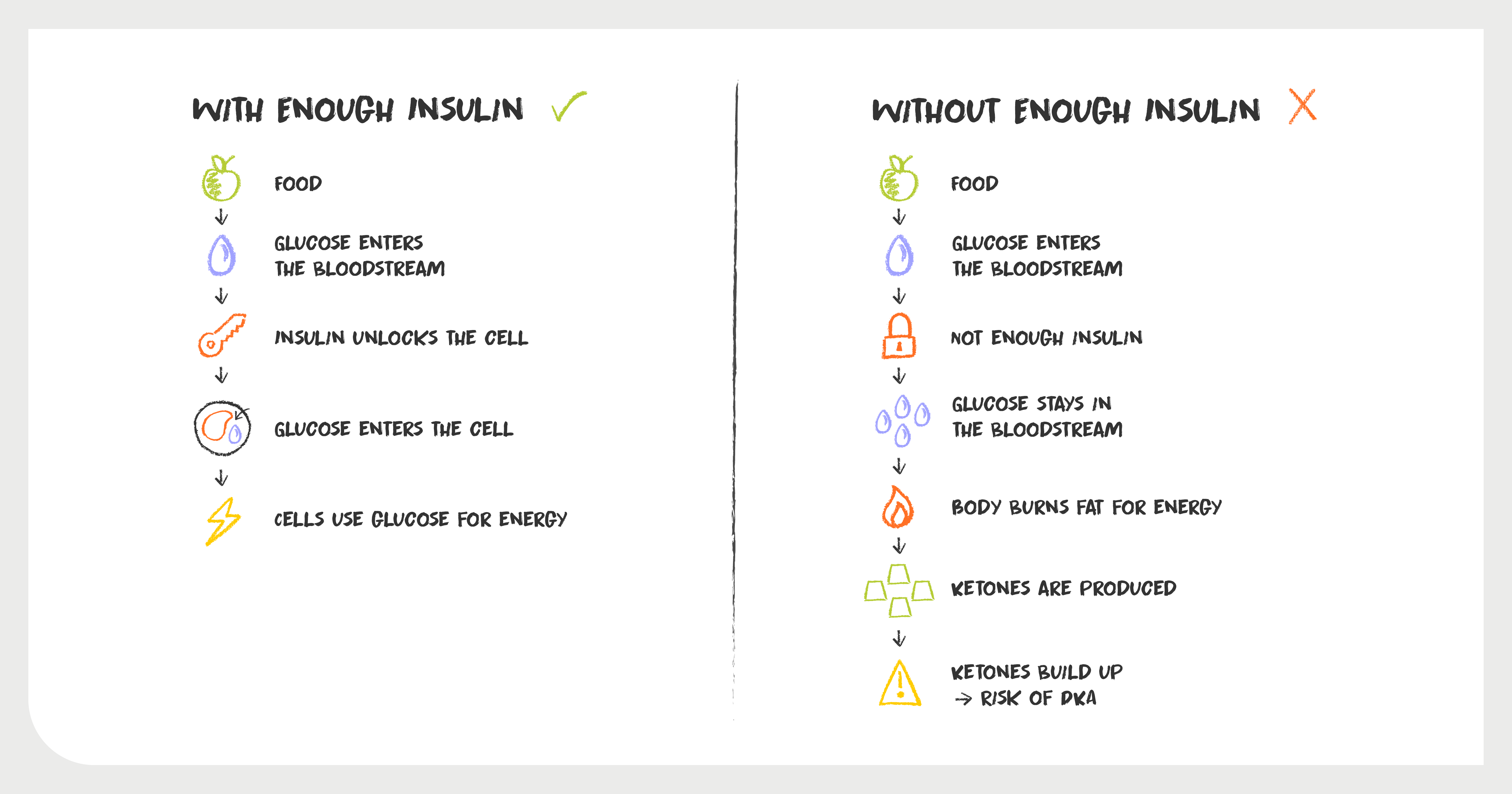
Think of insulin as a key that unlocks the doors to your cells, allowing glucose to enter and be used for energy. When there isn’t enough insulin, those doors can’t open, and glucose stays in the bloodstream.
When this happens, your body looks for another way to get energy. It starts burning fat instead.
As stored body fat is broken down, ketones are produced. While small amounts of ketones aren’t always dangerous, they can continue to build and lead to a serious condition called diabetic ketoacidosis (DKA).
It’s important to understand that ketones form because your body doesn’t have enough insulin, not simply because of high glucose levels (hyperglycemia).
Although high glucose often happens when ketones are present, the underlying issue is a lack of insulin, explains Diana Isaacs, PharmD, CDCES, an endocrine clinical pharmacist at the Cleveland Clinic who regularly helps people with type 1 diabetes (T1D) recognize and manage ketones.
Here, you’ll learn what ketones are, why your body produces them, and why spotting them early is an important part of preventing DKA.
Why ketones matter — even if you've never checked for them
If you live with T1D, you might assume ketones are something you don’t need to worry about — especially if you’ve never experienced them firsthand.
The reality is, many people never check for ketones beyond their first year of diagnosis. This can create a false sense of security.
Here’s the thing: Ketones can develop at any time when your body is insulin-deficient. They can also form at different rates in different people. So there’s no reliable way to know who will develop them quickly and who won’t.
That means even someone who has lived with T1D for decades — without ever developing DKA — could still make ketones if their insulin delivery is interrupted or their needs suddenly increase.
Understanding ketones isn’t about expecting an emergency. Rather, it’s about recognizing when they’re present and knowing when to take action, explains Isaacs. Which is why ongoing conversations with your care team are so important.
Your body prefers glucose for energy
Simply put, every cell in your body needs energy to function.
Most of the time, that energy comes from glucose, which your body gets from the foods you eat. Glucose can’t enter the cells on its own — it depends on insulin to help get it there from your bloodstream.
When enough insulin is available, glucose moves into your cells where it’s used to power your body.
What happens when there isn't enough insulin?
When insulin is in short supply, glucose starts to build up in your bloodstream.
Even though there may be plenty of glucose in your blood, your cells can’t use it for energy. So, your body switches to its backup plan: breaking down stored fat to make ketones for energy instead, says Risa Wolf, MD, a pediatric endocrinologist and director of the Pediatric Diabetes Program at Johns Hopkins Medicine.
At Hopkins, ketone education is a part of every diabetes care visit. Here, times to check for ketones, including when sick, vomiting, or with persistently elevated blood sugars, are reviewed, says Dr. Wolf.
Families are also taught that ketones “are a warning sign that the body may not be getting enough insulin,” she said. And when ketones are present, they receive guidance on how to reduce them by taking insulin and increasing hydration.
If you have a ketone action plan, follow the steps you’ve been given. If you don’t have one — or aren’t sure what to do — reach out to your diabetes care team for extra support.
How fat becomes ketones
Whenever your body burns fat for energy, it naturally produces ketones.
Ketones themselves aren’t “bad,” explains Isaacs. They’re simply an alternative fuel source your body makes when it can’t access glucose.
Dr. Andrea Mucci, MD, a pediatric endocrinologist at Cleveland Clinic Children’s, puts it another way: “Ketones are trying to help you!”
“Ketones help give your brain energy until you’re able to get insulin back,” she said. But there is a downside: “The more they try to help, the more acidic the blood will get, and it’s how someone ends up in DKA — if they don’t pay attention to them early enough.”
When do ketones become a problem?
Small amounts of ketones aren’t always dangerous.
People without diabetes can have low levels of ketones when fasting or exercising — and this is not necessarily dangerous, says Dr. Wolf.
People with type 1 diabetes can also have small amounts of ketones when they’re following a very low-carbohydrate diet, even while continuing to take insulin.
The concern arises when ketone levels continue to rise.
“Ketones can become concerning when there is not enough insulin in the body, blood sugars are high, and ketones are developing," explains Dr. Wolf. As ketones build, they can make the blood acidic, which can lead to DKA.
*Ketones can also be elevated without high sugar levels, like when you’re sick or vomiting.
Why ketones can happen with T1D
Ketones aren’t just a concern when you’re first diagnosed with T1D. They can develop at any time your insulin delivery is interrupted.
There are several reasons this might happen, including:
- Increased insulin needs: When you’re sick, you may need more insulin.
- Insulin pump infusion set failure: Your infusion site may be kinked or pulled out of the skin.
- Damaged insulin: If insulin is past its “use-by” date or exposed to temperatures that are too hot or too cold, it may not work as well.
- Insulin pump failure: When you have an unexpected pump problem, it may interrupt insulin delivery.
- Pump is disconnected: This can happen if you forget to reconnect your pump after showering or swimming.
- Battery problems: If your pump battery isn’t charged, it may fail.
- Phone problems: This can happen when the phone needed to operate your pump is lost, stolen, or broken.
- Missed insulin dose: You may forget to take an insulin dose.
People who use insulin pumps may be at slightly higher risk because they rely solely on rapid-acting insulin, says Isaacs. Without long-acting insulin in the body, an interruption in insulin delivery can lead to ketones within hours if it isn’t noticed and addressed.
Knowing when to check for ketones and taking action can help you avoid DKA.
What do ketones feel like?
The longer you go without getting enough insulin, the higher the ketone levels climb, and the symptoms may become more noticeable.
“Everyone’s body can make ketones in certain situations,” explains Dr. Mucci. “For a person with T1D, it can be a sign that your body doesn’t have enough insulin and can be a ‘warning sign’ for DKA.”
Early signs of ketones may overlap with those of high glucose, including:
- Increased thirst
- Frequent urination
- Tiredness
As ketones begin to build, symptoms can become more serious. These can include:
- Nausea and vomiting
- Abdominal pain
- Fruity-smelling breath
- Fast, deep breathing
“Ketones can sometimes cause a funny smell — some describe it as fruity or like nail polish remover — and you’ll likely feel tired,” says Dr. Mucci. “As the ketones become larger (meaning the insulin deficiency is getting worse and you’re getting closer to DKA), you may start to have abdominal pain and feel nauseous, and vomit. These are advanced and concerning symptoms.”
You may assume you are sick or have a stomach bug, but in someone with T1D, it can be a sign of ketones.
Ideally, everyone would have a personalized ketone action plan, with instructions tailored to their situation and current therapies, says Isaacs. That way, you would know exactly what steps to take if ketones became a concern.
Measuring ketones
Now that you know what ketones are and why they happen, the next step is learning when and how to check for them — and what your results mean.
Coming up in Part 2, you’ll find out:
- When you should check for ketones
- Different ways to measure ketones
- What blood and urine ketone results mean
- How to know when it’s time to take action
By knowing what ketones are, why they happen, and symptoms to watch for, you’ll be better able to recognize when something isn’t right — and take action before DKA develops.
Medical Disclaimer: T1D Exchange does not provide medical advice. The information in this article is for educational and informational purposes only and is not intended to replace guidance from your healthcare provider. If you have questions or concerns about your health, treatment, or diabetes management, please talk with your healthcare provider.