This is the second article in our series on severe hypoglycemia. In part one, Jennifer Sherr, MD, PhD, explained what counts as a severe low. Here we look at what comes after.
More Than a Single Moment
In part one, Dr. Sherr told the story of Maria, whose partner had to open her glucose tabs for her at 2 AM. Within a few minutes, Maria felt like herself again.
A severe low is any low where you need help from someone else to treat it and recover. When one happens, most of the attention goes to the moment itself. But the impacts of a severe low may not necessarily end when glucose comes back up. The effects can show up in the days, weeks, and even years that follow. A few weeks later, Maria might be eating a snack before bed, whether she needs one or not, taking a little less insulin with dinner, setting higher low alerts, or treating glucose levels that aren’t actually low as if they are. Her partner might be sleeping more lightly, waiting for the next alarm. None of that gets counted or measured as a severe low, but it can all be part of the cost.
Some lows are an expected part of living with type 1 diabetes (T1D). Every dose of insulin carries some risk, even when you’re doing everything right, and in T1D, the body’s usual backup systems, like releasing glucagon, don’t kick in the way they should. Diabetes also changes as life does: a move, a new job, a hiking vacation, an illness, or a new medication can all change how much insulin you need, and settings that worked last month may not fit this month.
Living with T1D also means every decision is a risk-benefit trade-off. How much insulin should I take for this meal? Should I correct now or wait? Is this workout going to make me go low? There’s some level of uncertainty in every choice, and you’re making them all day, every day.
A severe low can change that mental risk-benefit math: the risk side of the decision can suddenly receive a lot more weight than the benefit side.
Fear Is a Normal Response
After a severe low, most people feel some fear that it will happen again. That fear is rational and protective. And research backs up that instinct: in a large study of adults with diabetes (mostly with type 2), a severe low in the past year was the strongest predictor of having another one, and studies in people with T1D show the same pattern. What we want is to work through that fear without causing another low.
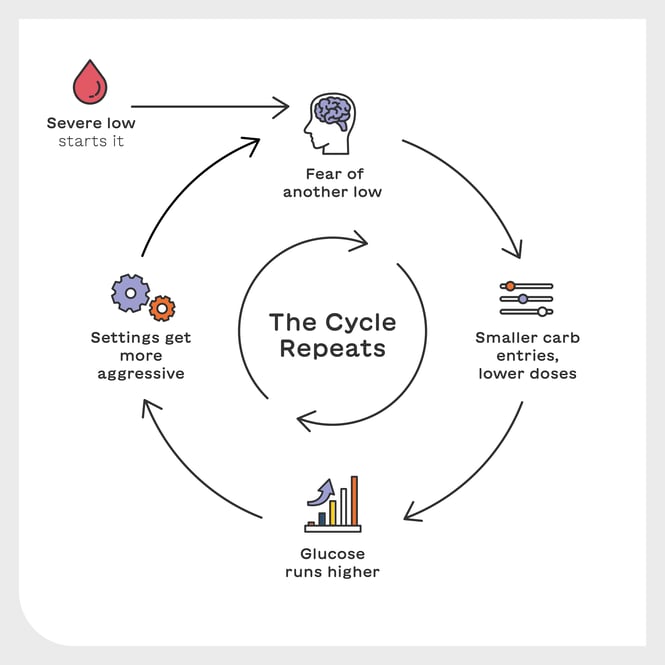
The problem is where that fear can lead you over time. Many people slowly “drift” their management upward to stay out of the danger zone. That might look like:
- Entering fewer carbs than you’re actually eating
- Lowering, delaying, or skipping insulin doses
- Using a higher glucose target (or exercise mode) all the time
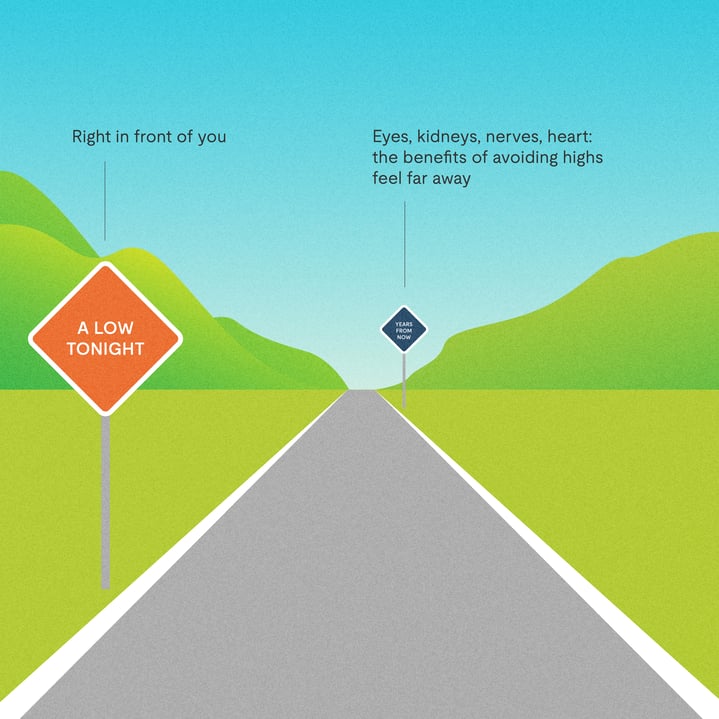
Part of the reason for this drift is how the two risks feel. A low is a risk sitting right there in front of you. The benefits of avoiding high blood sugar can seem farther away and are hard to picture. So, many people choose “I’m just going to make sure I don’t go low right now,” over and over again.
Running higher for a while after a scary low can be reasonable. But running high for years has real costs for your eyes, kidneys, nerves, and heart, and people with more fear of lows do tend to spend more time high. So the goal is to work your way back, at a pace that feels safe. That should be an active plan, not something you expect to happen on its own.
Why technology hasn’t solved this yet
Continuous glucose monitors (CGMs) and automated insulin delivery (AID) systems have made a big difference. But an AID system can only work with the settings it has and the information you give it. If carb entries get smaller after a scary low, the system doses for those smaller numbers. Carb entries do tend to shrink over time: in one study of Control-IQ users, entered carbs fell from about 132 to 100 grams a day over two years, while the system covered more with automatic boluses. That study didn’t look at why, but in the clinic, fear of hypoglycemia often seems to be part of it. Sometimes, a health care team then sees higher glucose levels and makes settings more aggressive. But that doesn’t help much if the carb entries just keep shrinking to make up for it. This isn’t a settings problem, and changing settings alone won’t fix it. The fear driving those changes has to be identified before anyone can address it in a meaningful way.
The Long-Term Picture: How Repeated Severe Lows Add Up Over Time
When severe lows keep happening, the effects add up. Some take years to show up. Others show up in daily life right away.
Over the long run:
- Warning signs can fade. Repeated lows can dull the body’s warning signs (impaired awareness of hypoglycemia), and people with impaired awareness have about six times as many severe lows.
- The heart. In a study of nearly 15,000 adults with T1D, people who’d had a severe low were hospitalized for heart and blood vessel problems about twice as often.
In everyday life:
- Thinking. Over 32 years of follow-up, people with more severe lows had bigger drops in how quickly and clearly they could think as they got older.
- Sleep. In a T1D Exchange survey, people with repeated severe lows and impaired awareness were about twice as likely to report a sleep disorder.
- Work. Only 40% of people with repeated severe lows and impaired awareness worked full-time, compared with 66% of people who had neither. Those who worked reported lower productivity.
- Exercise. Fear of lows is a major reason many people with T1D avoid exercise, which means giving up one of the best things we know you can do for your long-term health.
- Mood. Severe lows and depression also seem to feed each other: people with depression were almost twice as likely to have a severe low later, and people who’d had a severe low were more likely to develop depression.
Diabetes Burnout
A huge part of diabetes is mental health. At some point, stress, life events, or mental health will make managing insulin and diabetes feel like too much. In clinic, it’s sometimes helpful to normalize this experience by describing it as not a matter of if, but a matter of when. For most people, it’s mild and comes and goes: a stretch where checking, counting, and dosing just feel heavier than usual. For some, it builds into full burnout. Either way, it doesn’t mean you’re doing it wrong.
Fear of lows is one of the most common drivers. After a severe low, every dose, meal, workout, and night of sleep can come with an extra layer of worry, and carrying that all day is exhausting. Worry about lows is a recognized source of diabetes distress, and people with repeated severe lows report more of it. On top of that, health care often isn’t well coordinated. Between referrals, prior authorizations, pharmacy problems, and supply orders, you can end up doing a lot of work just to navigate the system, on top of managing your diabetes.
When someone is feeling burned out
First, name it and call it out. Then talk about it, so it feels normal, because it is. From there:
- Look for what’s driving it. Busy lives make it hard to step back and see what’s really going on, and part of a care team’s job is to help people look. Burnout isn’t the same as depression, but sometimes what’s driving it is depression, anxiety, or a complicated relationship with food or insulin, and that deserves its own care.
- Figure out how risky things are right now. Someone who sometimes skips a meal bolus may just need a few settings changes. Someone going many hours without insulin needs a different plan, and sometimes extra support from a mental health professional.
- Build a plan that fits. If fear of lows is part of it, the plan has to address the fear, not just the numbers. That might mean making better use of alerts and technology, a simpler routine for a while, or more frequent check-ins with a diabetes educator.
Who else can help
The American Diabetes Association (ADA) recommends making emotional health part of routine diabetes care. But there aren't nearly enough mental health professionals who focus on diabetes, so a lot falls to your health care team.
Diabetes educators are one of the most underused resources out there. Many people build a long-term relationship with theirs, and they're often easier to reach. Pharmacists can help too, especially with making sure changes from a visit are clear and actually happen.
Caregivers Feel This Too
Severe lows don't only affect the person living with T1D. Parents, partners, and other caregivers carry them too, often in the middle of the night. They sleep lightly, check the CGM app at work, and feel like it's their job to catch the next low. Some have had to give glucagon, and that stays with you.
Caregiver fear can also shape decisions for the person with T1D. Some people run higher partly so their family won’t worry. That’s worth talking about as a family, and with your care team.
One thing that comes up in the exam room: caregivers and the person with T1D don't always agree on how fast things should change. That's normal. Everyone in the room wants the same thing; they just see the pace differently. Your health care team can help here, because we're looking at the long run: steady progress, even if it feels slow, usually gets further than pushing hard and meeting resistance or another low.
Finding Your Way Back After a Severe Low
So how do you come back from a severe low without living in fear, or living high? It usually comes down to a few things.
Look at the bigger picture together
When someone uses a CGM or pump, it helps to turn the screen around and look at the data together. Most people check their numbers moment-to-moment. Few actually pull up their last couple of weeks.
Sometimes, just seeing how much time you've spent low next to how much time you've spent above 250 mg/dL is enough to change the conversation. Most people with T1D already know what they want their data to look like. Looking at it together, without judgment, helps.
Your goals, not mine
The goals should come from you. I push as little as I need to, so you can set your own goals. If they’re my goals, they won’t stick. If they’re yours, they might.
I borrow a line from Peloton instructor Denis Morton: "I make suggestions, you make decisions." It’s how I think about diabetes care, and I say it in clinic all the time.
Small steps, real wins
Perfect can be the enemy of good. A small change you'll actually make beats a big change that never happens.
So we take small steps. When the time spent low starts to come down, we celebrate that. Then we look for the next small step. I tell people all the time that “progress is progress.” Small improvements count, even if the numbers aren’t yet where you eventually want them.
We also try hard not to cause another low. A new low can break trust, both in insulin and in the plan. Scare tactics don't help either. Warnings about problems decades from now rarely work on a 21-year-old. They hardly work on me.
If someone isn't ready to change yet, that's not the end of the story. We'll look at it again in three months, or sooner if life changes.
Fear can tip the scale the other way
A quick aside, because it doesn’t get talked about much: fear can also push the numbers in the other direction. Some adults who have lived with T1D for decades were taught that a lower A1C is always better, and they’ve learned to tolerate lows to avoid highs. To keep that number down, they may take large doses whenever glucose rises even a little. The A1C looks great on paper, and kudos are given. But they can be spending a lot of time dangerously low. In one UK study, the group most focused on avoiding highs had the lowest average A1C, and also by far the most severe lows.
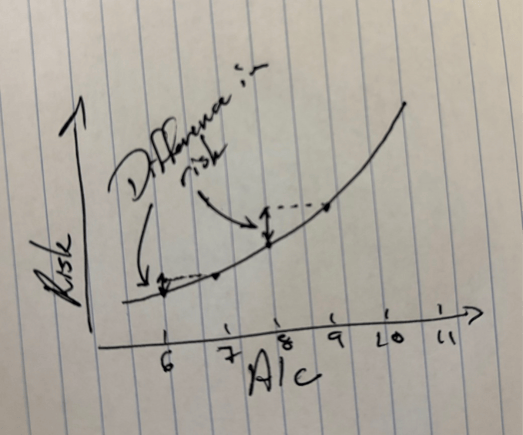 I often sketch a quick graph on a scrap of paper, a rough version of a well-known figure based on data from the landmark DCCT trial, with the risk of long-term complications on one axis and A1C on the other. Most people think that risk decreases in a straight line as A1C decreases. It doesn’t. Moving from an A1C of 9% to 8% reduces it much more than moving from 7% to 6%. And at some point, the risk of lows outweighs the benefit of going lower.
Sometimes, a “lower is always better” message has been conveyed, which can be dangerous. A1C targets should fit the person, and for some people, the safest target isn’t the lowest one. A1C and time in range are just numbers. They matter because of what they mean for your health, not on their own.
The approach is the same as above. We look at the data together, ask what’s really driving the decisions, and agree on goals.
Be ready, so lows feel less scary
Knowing how to handle a low can make the possibility of one feel much more manageable. That's why it's important to have glucagon on hand and easily accessible. Ideally, you never use it. It sits in your backpack, it expires, you throw it away, and you get a new one. What we don't want is a Saturday night when you need it, and it isn't there.
Next Steps: Start the Conversation
Many severe lows never come up at a visit. In a T1D Exchange survey, nearly 90% of people had at least one severe low that was treated outside of any health care setting. Some people don't realize those count. Others feel embarrassed or worry that it will be seen as a failure. Some worry about their driver's license, or about getting a lecture or a big change to their plan. And visits are short, with a lot to cover.
But your health care team can’t help with what they don’t know about. When a severe low doesn’t come up, we lose the chance to adjust your plan, check whether your warning signs have changed, talk about fear or burnout, or bring in a diabetes educator or other support. And since one severe low is the best predictor of the next, each one we hear about is a chance to prevent another.
If your team doesn't ask, bring it up yourself.
Questions to ask yourself before your next visit
- Did anyone have to help me treat a low, even just by handing me juice or opening a wrapper?
- Did I need glucagon, pass out, or have a seizure from a low?
- Have I had any lows that scared me, even if I treated them myself?
- Have I changed my carb entries, doses, settings, or targets because of a low?
- Has worry about lows changed how I sleep, exercise, drive, or work?
- Is someone in my family worried about my lows?
If the answer to any of these is yes, bring it up. And don't wait for your next visit. If a severe low happens, send your team a message through your online portal. If you've already changed your settings after a low, tell your team. It's often the right call, and together you can plan your next steps.
Fear after a severe low is normal, and it's protective. With your care team's help, you can work through it without living in fear or living high, one small step at a time.
This content was developed independently by T1D Exchange and was supported by a financial contribution from Vertex Pharmaceuticals.
Medical Disclaimer: T1D Exchange does not provide medical advice. The information in this article is for educational and informational purposes only and is not intended to replace guidance from your healthcare provider. If you have questions or concerns about your health, treatment, or diabetes management, please talk with your healthcare provider.